
How AI Is Reshaping the Gaming Industry's Entire Value Chain
From Tencent's prompt-to-game platform to AI-powered NPCs that 25 million players can't distinguish from humans — here's how artificial intelligence is restructuring every link in gaming's value chain.
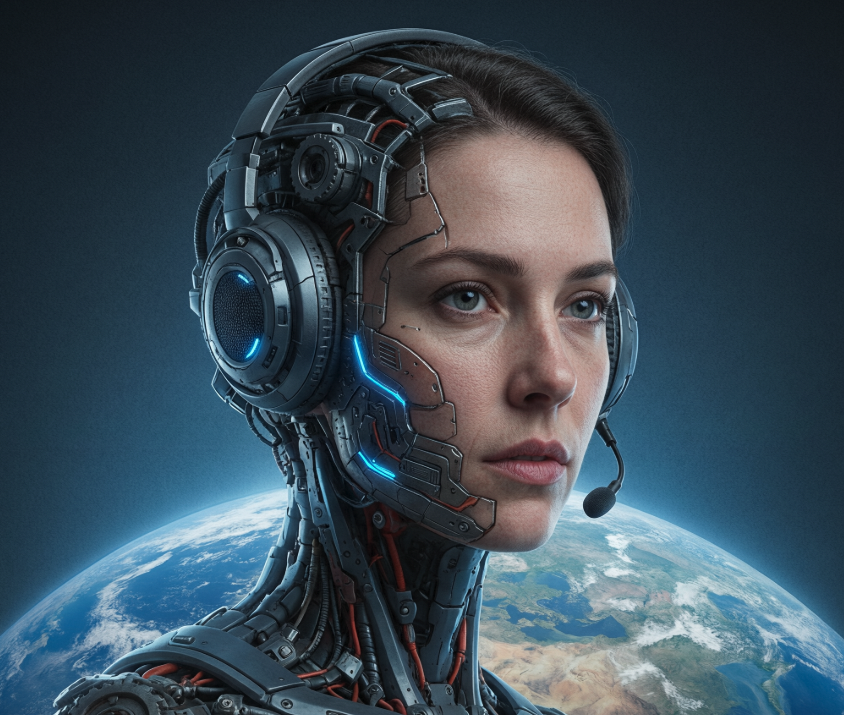
AI has moved from a backend productivity tool to a force restructuring how games are built, distributed, and played. From solo devs using natural language prompts to AI NPCs blurring the line between player and machine — the entire value chain is shifting.
A few years ago, conversations about AI in gaming usually revolved around one thing: making games cheaper and faster to make. Today, that picture looks completely different. AI has moved from a backend productivity tool to something that's quietly restructuring how games are built, distributed, and even played. The shift is happening across the entire industry – from the way a solo developer can now build a playable game with nothing but natural language prompts, to the way a major studio's AI-powered NPCs are blurring the line between player and machine. Let's trace how this is unfolding.
The Production Side: From Cost Centre to Creative Engine
The most immediate impact of AI has been on development itself – and the numbers are hard to ignore. Morgan Stanley Research estimates that AI could unlock $22 billion in additional profits for the video game industry through lower production costs and faster development timelines. That's not a small number. It's a structural shift.
What's driving this? Across the development pipeline, AI is being applied at every stage: In planning and design, AI is already handling around 55% of creative ideation and prototyping work. Developers use it for brainstorming, sorting through research, and generating early gameplay concepts. On the art side, 2D asset generation, texture work, and animation interpolation have become standard. 3D asset creation is still in its early days, but the efficiency gains are already visible. For programmers, AI code generation and automated testing have cut development time significantly. By the end of 2025, Unity developers were spending 77% less time on core development than they did in 2022.
One analysis estimates that AI could reduce the global game development workforce requirement by roughly one-third, delivering a 52% overall efficiency gain across the industry – equivalent to about $20 billion in cost savings.
The real story, however, isn't just efficiency. It's access.
Democratisation: When Anyone Can Build a Game
This is where things get genuinely interesting. AI is lowering the barriers to entry so dramatically that the old distinction between "developer" and "player" is starting to dissolve.
In May 2026, Tencent unveiled "Project Craft" – an AI-powered game creation platform that allows users to build 2D and 3D games through natural language input. You don't need to know how to code. You don't need to understand 3D modelling. You just describe what you want, and the AI handles the rest.
The platform comes with over 20,000 pre-made assets and a full AIGC pipeline that can generate character art, 3D models, animations, scenes, audio, and UI – all through simple prompts. It's designed to serve both complete beginners and professional developers, with visual tuning panels that let you adjust game balance, character stats, and rules without touching a single line of code.
As one industry observer put it, the platform's goal is to make it possible for "one person to be an entire game studio". That's not hyperbole. It's a plausible description of what's becoming technically feasible.
BCG estimates that roughly 50% of game studios are now using AI in some form, and the adoption is accelerating. Even AAA studios, initially hesitant, are moving forward – EA's partnership with Stability AI in October 2025 was a clear signal that the major players see this as the future.
AI in the Game: When NPCs Stop Being Predictable
The most visible change for players isn't happening behind the scenes – it's happening inside the games themselves. AI-powered NPCs are no longer a gimmick. They're becoming a core gameplay mechanic.
In January 2026, Giant Network launched an "AI Big Model Challenge" in its hit mobile game Supernatural Action Group, embedding AI directly into the game's core PvP loop. The NPC "fakes" are driven by real-time AI, not scripted behaviours. They can speak, mimic human players, infiltrate teams, and launch attacks at unpredictable moments. Within a week, AI had participated in over 25 million matches.
Players can't tell who's real and who's AI. That uncertainty creates a new kind of gameplay tension – one that simply wasn't possible before large language models entered the picture.
The technical stack behind this involves speech recognition (ASR), large language models (LLM), and text-to-speech (TTS) working in concert. The AI understands player intent, mimics human tones and speech patterns, and adapts its strategy based on the in-game situation. It's not just a smarter bot. It's a fundamentally different kind of opponent.
This represents a shift from AI as a tool to AI as a participant. As one analysis put it, the industry is moving from "content industry" to "intelligent interactive industry".
Narrative and Interaction: The Rise of "Generative Play"
Beyond combat and strategy, AI is also changing how stories are told in games. A notable example is Historical Simulator: Chongzhen, an indie game released on Steam in May 2026. Players pay a one-time fee for the game, then spend token points to interact with AI-driven historical figures like the emperor Chongzhen, General Sun Chengzong, and the eunuch Wei Zhongxian.
There's no pre-written script – every dialogue is generated in real time based on the player's input. The story emerges from the interaction, not from a branching tree designed months earlier.
The game sparked a wave of discussion, both positive and critical. Some praised it for allowing genuine historical exploration – you can actually test what happens if you make different decisions as the last emperor of the Ming dynasty. Others criticised it for feeling incomplete, with inconsistent character behaviour and a business model that some felt was exploitative.
But whether it succeeds or fails as a product, it points to something bigger: the shift from "scripted narrative" to "generative narrative" is underway. Developers are moving from crafting every plot point to defining the rules of a world and letting the AI generate the story in response to player actions. As one developer put it, the future of interactive storytelling might look more like a "generative network" than a "branching tree". That's a fundamental change in how games are designed – and how players experience them.
The Platform Shift: Distribution and Discovery in an AI-Flooded World
There's a less visible but equally important shift happening at the distribution level. As AI makes game creation cheaper and faster, the number of games being produced is set to explode. BCG's analysis of Steam metadata found that around 20% of new games were disclosing AI use by mid-2025 – double the figure from the previous year.
More games mean more noise. And in a noisy market, discovery becomes a premium.
This presents a dual challenge. On one hand, platforms like Steam and Roblox stand to benefit from increased transaction volume. On the other, the flood of what BCG calls "gameslop" – low-quality, derivative AI-generated titles – could overwhelm curation systems and frustrate players.
The winners in this environment are likely to be platforms that can solve the discovery problem – through better algorithms, stronger community curation, or robust user-generated content ecosystems. As one analysis put it, "in the era of supply expansion, distribution efficiency and community ecology become scarce capabilities".
The Challenges Ahead
It's not all smooth sailing. Several significant issues remain unresolved.
Quality control is a major concern. AI-generated content can be inconsistent. Characters can break character. NPCs can forget previous interactions or behave in ways that contradict their established personality. For a commercial product, these aren't minor bugs – they're experience-breaking failures.
Cost is another hurdle. Running large language models in real time is expensive. Every AI interaction consumes computing power, and that cost scales with player numbers. Some developers have experimented with letting players bring their own API keys to offset the cost, but that introduces other problems – inconsistent experiences and potential security risks.
Copyright and intellectual property are becoming urgent issues. AI models are trained on vast datasets of existing work, often without permission or compensation. As one industry expert noted, even if a studio doesn't intend to infringe, the similarity of AI-generated output to existing copyrighted material can lead to legal disputes.
And then there's the human factor. As AI takes over more of the production pipeline, the industry faces a potential talent crisis. If junior roles in art, writing, and programming get automated away, where will the next generation of senior creatives come from? Some argue that AI should be used to augment human creativity, not replace it – but the industry hasn't fully figured out how to make that work in practice.
What's Next
The consensus across analysts, developers, and publishers is that we're at the beginning of a major transition. AI is moving from a productivity tool to a structural force – reshaping not just how games are made, but what they are.
Morgan Stanley sees AI as a competitive advantage for established publishers with strong IP and live-service operations, but also notes that it lowers barriers for new entrants. BCG believes cloud gaming and AI together will push the industry toward a "hardware-agnostic future" where platform wars become less relevant. Huatai Securities expects AI to open $20 billion in new market opportunities through innovations in gameplay and monetisation.
The companies that succeed in this new landscape won't be the ones that simply adopt AI. They'll be the ones that figure out how to use it to do something genuinely new – something that wasn't possible before. The technology is here. The question now is: what will developers build with it?