
Why Does This Game Have Seven Different Currencies and Why Can't I Buy Anything With Any of Them
Gold, diamonds, event tokens, guild coins, PVP medals, battle pass stars, and something shaped like a gear. Six figures of "money" and still can't afford anything. Here's how multi-currency design really works — and who it works for.
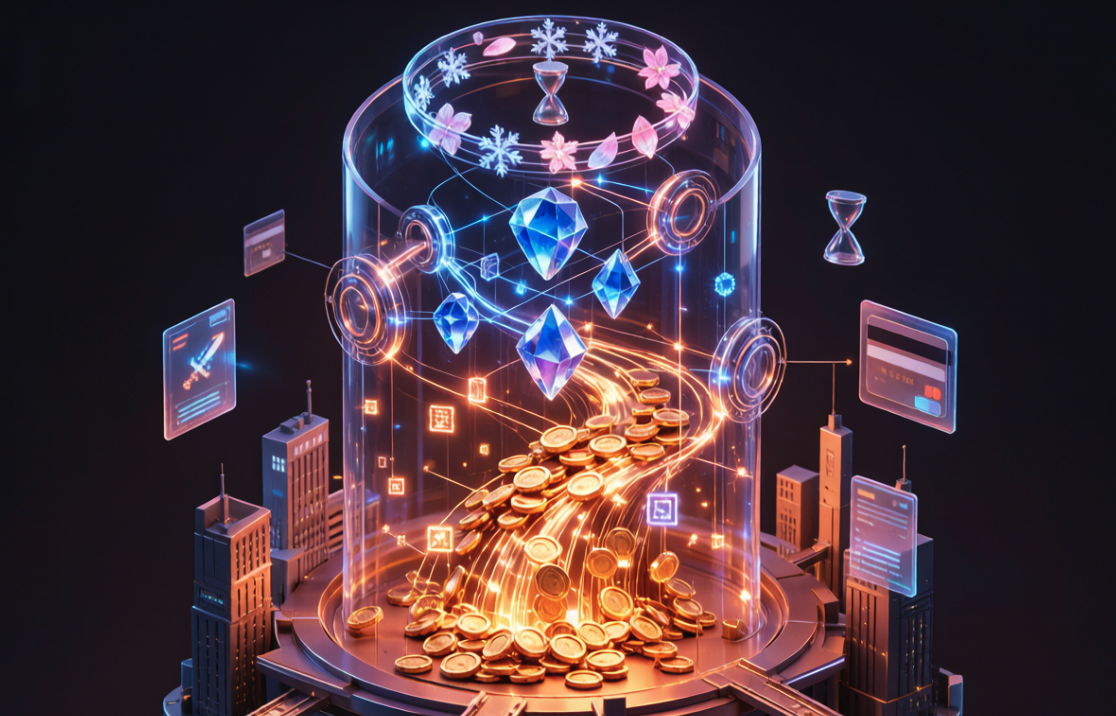
Seven currencies, six figures of in-game "money," and still can't buy what you want. That's not an accident — it's the design working as intended.
I opened a mobile game the other day—won't name it, doesn't matter, you've played one like it—and stared at my wallet screen. Gold: 147,382. Diamonds: 42. Event tokens: 287. Guild coins: 1,204. PVP medals: 15. Battle pass stars: 23 out of 100. Some other thing shaped like a gear with a number next to it that I genuinely don't remember earning.
I had six figures of "money" and couldn't afford the thing I wanted.
That's not an accident. That's not a UI oversight. That's the design working exactly as intended, and I want to talk about how we all got here.
One Currency Would Be Too Easy, Apparently
Let's start with the obvious question: why not just... one currency? Gold. Everything costs gold. Kill a monster, get gold. Sell an item, get gold. Want a skin? Gold. Want to upgrade? Gold. Clean. Simple. A child could understand it.
The answer—and I'm going to give the real answer, not the official one—is control. One currency means players who grind efficiently can get everything without paying, and players who spend money don't need to play. Both of those are bad for business.
So instead we get layers.
Soft currency (gold, coins, whatever). You earn this by playing. Lots of it. More than you'll ever need for the basic stuff, not nearly enough for anything good. It's the free sample at a grocery store. Enough to keep you browsing, not enough to feed you.
Hard currency (diamonds, crystals, gems). You buy this with actual money. You can earn tiny amounts through gameplay—like, microscopic amounts, the kind where after three months of daily logins you might afford one mid-tier item—but the real supply comes from your wallet. These are the game's "real" money. Everything else is Monopoly money.
Event tokens. Only available during a two-week window. Expire when the event ends. If you don't use them, they vanish. Their entire job is to make you log in during the event and feel anxious about wasting them.
Then some games add guild coins. PVP medals. Reputation points. Battle pass stars. Seasonal currency. Limited-time collaboration currency. Before you know it you've got a wallet screen that looks like a foreign exchange trading desk. I've seen games with eight, nine, ten currencies. I'm not exaggerating. I wish I were.
The Part Where They Let You Trade Between Them (But You Always Lose)
Here's where it gets insidious. The currencies aren't separate. They're connected through exchange systems that always, always, always work in the house's favor.
The classic setup: you can convert soft currency to hard currency through gameplay—very slowly. And you can convert hard currency to soft currency through spending—very quickly, but at a bad rate. The asymmetry is the point.
Think of it like an airport currency exchange. You walk up with dollars, you walk away with fewer euros. Then you try to convert those euros back to dollars. You get even less. The game skims from both directions, and the skim is the profit margin.
Ni Shui Han did something interesting here—they ran with a dual-currency system (copper and Jiao Zi) where you could convert between them, but the rates were tightly managed. Players hated it. Felt confusing, felt unfair, felt like the game was hiding the real costs behind math. Eventually the developer unified everything into one currency, which was genuinely bold for an MMORPG. The community called it a step forward for the entire domestic MMORPG space, and I think they were right.
But most games go the other direction—more currencies, not fewer. Some frameworks now map currencies to specific behavioral modules: growth currencies for leveling, activity currencies for events, PVP currencies for competitive modes, social currencies for guilds. Each one is tied to a specific thing you're supposed to do. The exchange rates between them are calibrated to push you toward the behavior the developers want.
Translation: if the PVP currency converts well to the growth currency, suddenly everyone's in the arena. If it doesn't, the arena's a ghost town. The exchange rate isn't just an economic lever. It's a traffic controller for the entire game.
Inflation, Sinks, and the Quiet War Against Your Hoarding
You know how in the real world, governments print money and sometimes things get more expensive? That happens in games too. Except game economies are completely artificial. There is no Federal Reserve. There's just a designer with a spreadsheet deciding how much gold a goblin drops.
Every game economy runs on the same two forces: sources (things that create currency) and sinks (things that delete it). Quest rewards? Source. Monster drops? Source. Login bonuses? Source. Repair costs? Sink. Consumables you actually use? Sink. Taxes on trades or exchanges? Sink.
If sources exceed sinks, you get inflation—too much gold chasing too few items, prices spiral, new players can't afford anything, veterans have Scrooge McDuck vaults full of useless money. If sinks exceed sources, you get deflation—currency is too scarce, players hoard it, nobody spends, the economy freezes.
The balance is absurdly delicate, and developers have some genuinely clever tools for managing it.
Exchange fees are the most common one. When you convert gold to diamonds, the system takes a percentage. That percentage? It's not going anywhere. It's being deleted from the economy—a silent tax that slows inflation without most players ever noticing. Blockchain games take this to its logical extreme: every transaction costs gas fees, and total token supply is hard-capped. Real scarcity, or at least, scarcity that a smart contract enforces.
Ni Shui Han's one-currency move is instructive here too. A unified economy is simpler, more transparent, and players trust it more. But it's also harder to control. With multiple currencies, you can inflate gold without touching diamonds, or drain event tokens without affecting the main economy. With one currency? Every adjustment hits everything at once. It's like trying to perform surgery with a sledgehammer. Possible. Not recommended.
The Psychology Part (Where We All Get Played)
Let's be honest about what's happening here. Multiple currencies aren't purely an economic design choice. They're a psychological operation.
The friction is the feature. Every time you have to convert currency A to currency B to buy item C, there's a moment of hesitation. A moment where the game's premium currency shop is one tap away. A moment where you think: "I could grind for three more hours... or I could spend five dollars and be done." The conversion friction doesn't just cost you game currency. It costs you willpower. And willpower is a finite resource.
Then there's the bundle trick. Premium currency is almost never sold in amounts that match item prices. The skin costs 800 gems. The gem bundles come in packs of 500 and 1,200. You buy the 1,200 pack, get the skin, and now you've got 400 gems left over. That leftover 400 sits there, burning a hole in your virtual pocket, until you buy more gems to reach the next purchase threshold. It's the gift card effect, digitized.
Event tokens add another layer. They expire. Use them or lose them. Your brain, which evolved to hate losing things more than it enjoys gaining things, will make you log in on a Tuesday night you had other plans for, just to spend tokens on a cosmetic you didn't really want but couldn't bear to see wasted.
PUBG's "Black Blade Coin" controversy is the extreme version of this. The proposed currency could be traded on Steam for actual money—convert in-game earnings into Steam Wallet funds. Which sounds great until you realize it blurs the line between game economy and real gambling. Regulators took notice. The question wasn't "is this fun." The question was "is this an unlicensed financial product." When your currency system gets that question asked about it, you've taken something too far.
Where I Land on This
I don't think multi-currency systems are evil. Some of them are actually kind of elegant when you step back and look at what they're solving—keeping free players engaged while giving spenders something to buy, managing inflation without killing the fun, creating seasonal rhythms that keep the game feeling alive.
But there's a line. And a lot of games cross it.
When I open my wallet and see seven currencies and can't remember what four of them do, that's not elegance anymore. That's obfuscation disguised as depth. When exchange rates feel deliberately confusing, when bundles never match prices, when event tokens are calibrated to make me feel like I'm losing something if I don't play on a Wednesday—that's not game design. That's casino design with better graphics.
A good currency system disappears. You earn. You spend. You understand what things cost without needing a calculator and a wiki. A bad currency system makes you feel like the game is speaking a language you don't, and the translator costs $4.99.
The games I've stuck with longest all share something: I know what their currencies are worth. Not in abstract game-design terms. In felt terms. I know that 5,000 gold is "a lot." I know that 50 diamonds is "I should save these." The numbers mean something because the system is transparent enough that meaning accumulates over time.
The games I quit? I couldn't tell you what anything cost. Not really. And I think that was the point.